
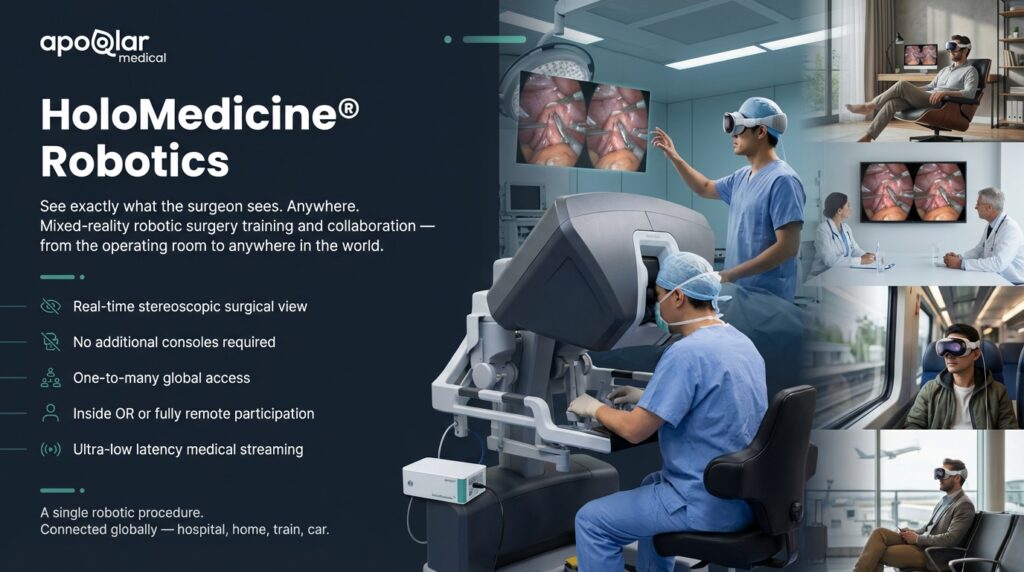
Hamburg, Germany – apoQlar today announced a groundbreaking approach to bring spatial computing capabilities into robotic surgical training and real-time proctoring, via the HoloMedicine® Robotics platform. The solution seamlessly integrates Apple Vision Pro, HoloStreamer®, and apoQlar’s HoloMedicine® Robotics software, enabling surgeons across the globe to train, observe, mentor, and proctor procedures both inside and outside the operating room.
The new system allows surgical teams to stream stereoscopic 3D (and standard 2D) video feeds from any compatible surgical robot directly to remote participants, who can view the procedure using Apple Vision Pro. Proctors, trainees, and expert consultants can annotate, record, and interact in real time, fostering global collaboration and mentorship across time zones and institutions.
Apple Vision Pro seamlessly blends digital content with the physical world and unlocks powerful spatial experiences, and HoloMedicine® takes advantage of visionOS’s infinite canvas for training and proctoring opportunities.
Key Features & Benefits
“Our goal has always been to thoughtfully integrate innovative technologies into surgical practice to enhance education, collaboration, and ultimately patient outcomes,” says Cornelius Thiels, hepatobiliary and pancreas surgeon at Mayo Clinic, who helped develop this technology. “By exploring new tools like spatial computing, we’re reimagining how surgical training can be delivered more effectively and accessibly, helping prepare the next generation of surgeons to provide the highest level of patient care.”
The technology is already in use in several pilot sites worldwide. Early insights report improved trainee comprehension of depth and instrument handling, more immediate feedback from mentors, and a transformative sense of presence for remote participants. Because the system is hardware-agnostic to any surgical robot (as long as the video feed is available) and network-capable, it can connect surgeons anywhere in the world.
The HoloMedicine® Robotics platform is being rolled out initially in select academic and clinical centers. Broader access will follow in phases, with the goal to make the solution accessible globally by Q1 2026. apoQlar will continue to refine streaming performance, expand supported robot systems, and add future capabilities (e.g. 360° OR views, multi-party annotation, additional overlays).
For more information, visit http://www.apoQlar.com